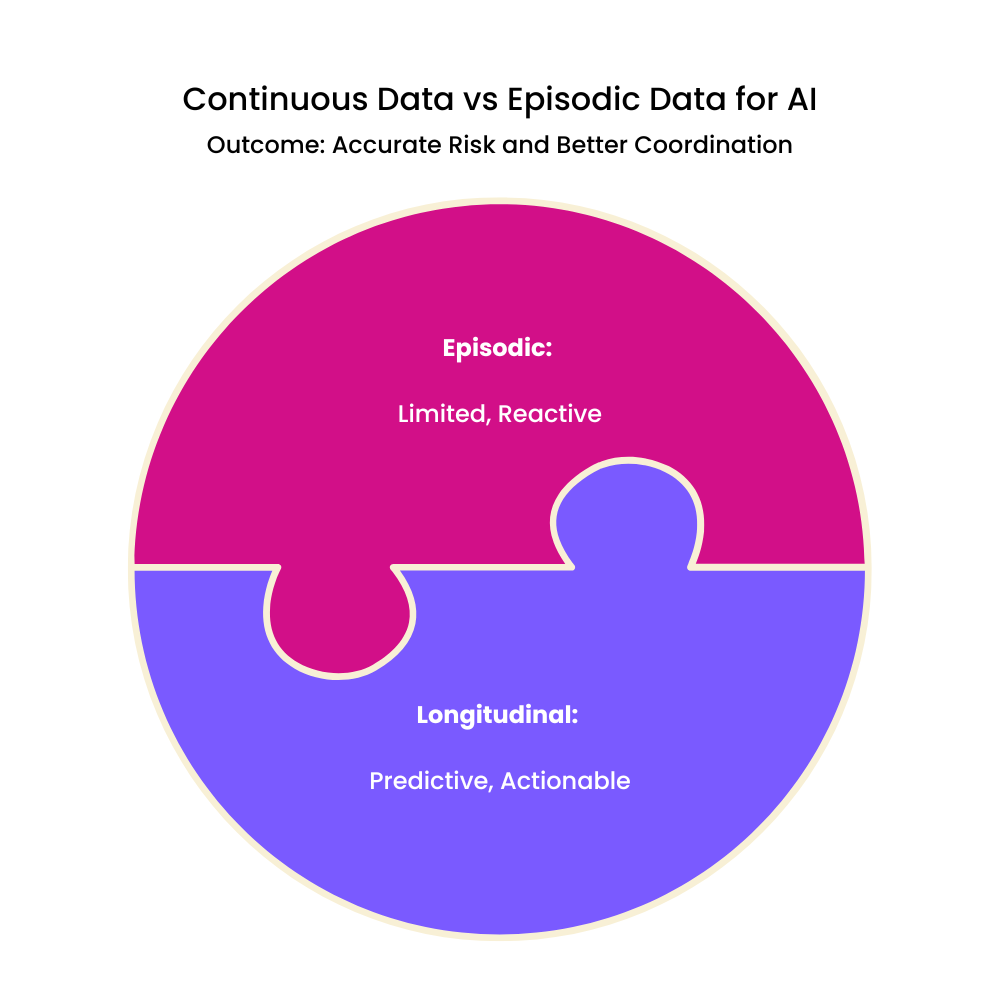
AI models work best when they can see the full sequence of events. Episodic encounters capture only a moment in time. They leave out behavior, adherence patterns, and reactions to therapy.
Value-based care depends on prediction. Without continuity, prediction is weak.
How Longitudinal Data Strengthens AI and Decision Support
1. Richer Feature Sets
Time-based trends reveal real patterns.
2. Better Risk Stratification
Chronic conditions show distinct trajectories over months or years.
3. More Accurate Predictions
Models can detect deviations early.
4. Improved Recommendations
Decision tools can suggest next steps with more confidence.
Impact on Patient-Centered Care
1. Personalized Interventions
Continuous data enables tailored outreach.
2. Better Engagement
Patients receive relevant nudges based on real behavior.
3. Stronger VBC Scorecards
Complete data improves reporting accuracy.
4. Team Coordination
All teams rely on the same context-aware insights.
Read the full whitepaper to understand the architecture behind real-time harmonization and longitudinal records.
AI integration with FHIR, API-based prior authorization, API-driven care coordination, API-first healthtech platforms, API-powered value-based care, Apple Health patient access, Argonaut Project FHIR, cloud-native health platforms, CMS interoperability mandates, CTO healthcare architecture, Da Vinci Project use cases, digital transformation in hospitals USA, EHR integration using FHIR, FHIR APIs in US healthcare, FHIR-based analytics dashboards, GPT for EHR unstructured notes, healthcare API adoption ROI, healthcare API governance models, healthcare API security OAuth2, healthcare CIO tech strategy, healthcare data interoperability, healthcare microservices architecture, HIPAA-compliant APIs, HL7 FHIR implementation, LLMs for clinical data, MyChart FHIR API, ONC FHIR API rules, payer-provider data exchange, real-time clinical data exchange, SMART on FHIR adoption, structured API data for population health
People are becoming more and more aware of their rights and privacy as a result of the tremendous shift to digitizing personal information. Healthcare organizations